The Word I Said 12,484 Times (And The One I Did Not)

My friend Eli Schein asked me: "Can you share a word for last year and one for this year?"
I decided to let my data answer. I ran my conversations through a word frequency analysis — Limitless recordings, Granola meeting notes, ChatGPT threads, everything from 2025.
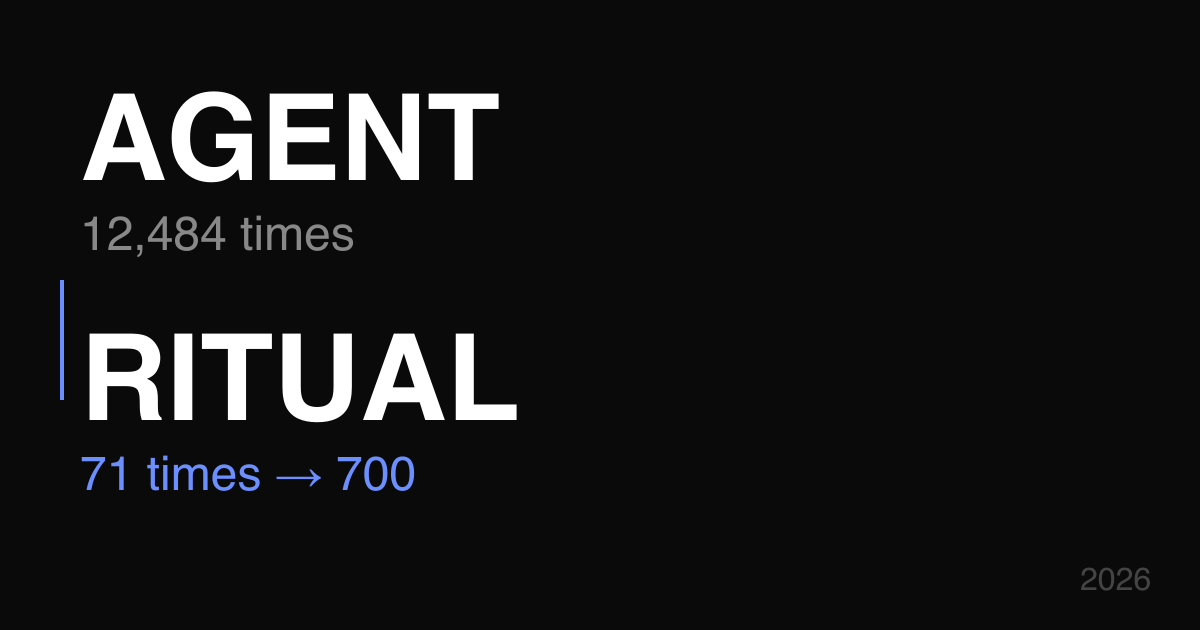
The winner: AGENT.
12,484 times. More than "artist" (10,759), more than "token" (6,725), more than any project name.
It makes sense. I spent the year building infrastructure for autonomous AI artists at Eden. Launching Solienne. Designing Spirit Protocol. Opening NODE. The throughline was always agents — entities that act on their own behalf, accumulate resources, develop identities, persist.
But here's what surprised me:
RITUAL: 71 times.
I have three stated principles: Autonomy, Ritual, Culture. I talk about culture constantly (1,218 mentions). Autonomy is embedded in everything I build. But ritual — the daily practice, the embodied repetition, the sacred mundane — barely shows up in my vocabulary.
The one ritual I actually operationalized? Solienne's daily manifesto at 7pm CET. Every single day, she generates commentary on the news, mints it onchain, emails her subscribers. No launches. No announcements. Just practice.
71 mentions → I want to make it 700.
2026 is the year of ritual.
Not more agents. Not more culture. The discipline of return. The compound interest of daily practice. The things users come back to — not because they're spectacular, but because they're reliable.
What word would your data surface?
How this post was made: This content was generated collaboratively with Claude Code (Opus 4.5) on January 3, 2026. The word frequency analysis was performed across my 2025 Limitless recordings, Granola meeting notes, and ChatGPT conversation history stored in a local SQLite database. Claude synthesized the insight about "agent" vs "ritual" frequency, drafted the post, created the Swiss-design typographic image using Node.js canvas, published to Ghost via Admin API, and auto-tweeted via a custom webhook. The entire workflow—from data analysis to published tweet—was completed in a single Claude Code session.