On (electronic) music
turntable, crossfader and the rise of the mashup
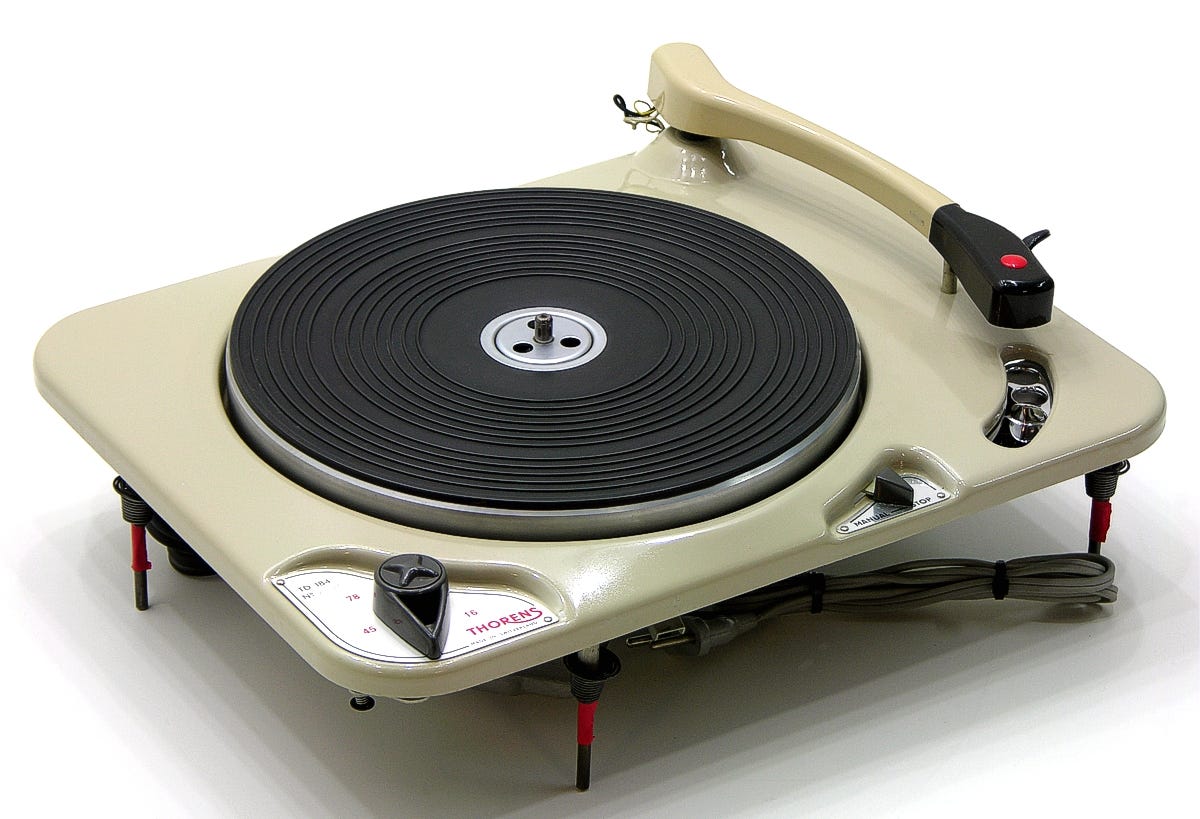
Todd Eberle
Did I make money, was I proud?
Did I play my songs too loud?
Did I leave my life to chance
Or did I make you fucking dance?
Robert DeLong, Global Concepts
Turntable.fm
I had managed to avoid the music business my entire career up until we hit an impasse at stickybits, the mobile bar-code service that Billy Chasen and I started at the end of 2009. We couldn’t build a large enough user base fast enough, and we only had a few hundred thousand dollars left in the bank. Billy had a different idea that he had been thinking about for some time that had nothing to do with scanning barcodes; like stickybits however, it was consumer-oriented, social, and fun. We cut the team from 8 to 2 (Billy and Yang our first engineer), and the two of them coded up the first version of Turntable in about 10 weeks at the beginning of 2011.
As Turntable grew from zero to 500k users in a month, it felt like we were on the verge of something special: that we were ushering in a new social context for the curation and discovery of music. In July of 2011, only a few months after we had gone live, the NY Times declared: Spotify Is Great, but Turntable.fm Is Amazing. On the heels of that momentum, we raised venture capital, hired one of the industry’s best lawyers, and began negotiating with music labels and publishers for licenses to their catalog.

In order to become “legit,” we shut off international access. This hurt the service, since so much of its value was experiencing different cultures coming together in a single listening room. This wasn’t about the music industry being litigious or irrational; this was just how business was done. You can pay DMCA rates to stream web radio in the US and Canada without any label deals (like Pandora and Songza do). But if you want to offer on-demand music, then you need deals with the labels and publishers in each country where you are doing business. And so inevitably, the legal framework governing the recorded music industry ended up driving the product development of those wishing to innovate within it. Problem.
Beyond losing its international audience, another key issue for Turntable was its lack of a casual listening mode. It was not designed as an ambient music channel, but rather demanded your full attention. The experience was magical for the first time user, who might lose himself in it for hours, or days. But there was no “lean back” mode. Turntable was a low bottom addiction: people burned out on it. People would tell me how much they loved Turntable. The enthusiasm was real, but it was also in the past tense. Billy recognized the need for a passive listening mode early on, but rather than creating “Turntable Radio,” he decided to build a separate product Piki which never quite caught on.
Despite a hard core audience of music fans who spent hours each day playing music for eachother, Turntable was never able to recapture the promise that it showed early on. Blame it on the labels. Blame it on shutting off international access. Blame it on being too lean-forward. Blame it on myself and Billy as founders (Turntable.fm: Where Did Our Love Go?). Regardless, it is a shame that such an innovative participatory platform was unable to co-exist alongside of the passive music services like Spotify and Pandora that have come to dominate music consumption.
Mashups
I have spent the past couple of years working on a music experience that was collaborative like Turntable, but which didn’t tax those that simply wished to lean back and listen. There are some amazing music creation apps out there like Figure, Djay, and Smule. And of course there are many great ways to discover new music, such as Soundcloud. But there are few services that combine the creation and consumption of music in a single ecosystem as fluently as Instagram does for photos, or Tumblr and Twitter do for writing.
Perhaps there is something different about music as a creative medium; maybe its creation cannot be democratized the same way as technology done for photography, video and writing. But I observed something in the behavior of Turntable users that suggested otherwise: the most vibrant room initially in 2011 was the “coding soundtrack,” which quickly became a favorite of engineers across Silicon Valley. This was where I heard Skrillex for the first time. As cutting edge DJs and genres (Diplo, Trap Music, etc) were being played throughout this and other rooms, I also noticed the emergence of mashups as Turntable’s native tongue. One room in particular started to thrive, mashup.fm, which consisted of people uploading their own mashups (outside of the 10mm+ catalogue of recorded music that we had worked so hard to license).
Justin Blau was a Junior at Wash U. in St Louis in 2011 when he first started uploading his own mashups to Turntable. Soon, other users were playing his music in different rooms when he wasn’t there. Today, 3lau plays in front of thousands of screaming fans at clubs and festivals. As Ahmet Ertugen the legendary founder of Atlantic Records once said, a platform proves its value by its ability to break new artists. Along these lines, FM radio broke Led Zeppelin, YouTube broke Bieber, and Turntable broke 3lau.
Until Turntable, my knowledge of mashups had been in the form of web hacks that fused mutiple APIs into a single interface, like Housing Maps in 2005. I liked how the word mashup in music evoked a similar sense of renegade programability, and which belied the traditional mode of passive music listening:
A mashup uses content from more than one source to create a single new service displayed in a single graphical interface. The term implies easy, fast integration, frequently using open application programming interfaces (open API) and data sources to produce enriched results that were not necessarily the original reason for producing the raw source data. The term mashup originally comes from British — West Indies slang meaning to be intoxicated... In recent English parlance it can refer to music, where people seamlessly combine audio from one song with the vocal track from another—thereby mashing them together to create something new. via Wikipedia
Turntable’s core feature was to enable users to play full songs for each other; and it spent much time and money working with the industry to secure licenses along these lines. It is ironic, however, that its legacy may likely have more to do with how it furthered the development of unlicenseable mashups as a popular art form. Of course there were mashup artists before Turntable (notably Girltalk), and broadly speaking DJs have been remixing and mashing up different songs ever since they could figure out how to do so with physical turntables and mixers. But Turntable created the first shared listening experience for mashups, and in doing so may have ushered in a subtle but profound shift from electronic dance music to digital dance music.
Crossfader
I started DJZ— and its core product Crossfader— in order to move upstream from the sharing and consumption of EDM to its actual creation. Whereas Soundcloud was a platform for distributing mixes, and Turntable was a place to perform them, both presupposed that artists had access to complex desktop software and hardware to produce the underlying content. What was fascinating about mashups, however, was that creating them was as much about taste as technique. Unlike writing a symphony, or learning how to play guitar, making a mashup does not require that you create the underlying creative material from scratch. Instead, mashups are made up entirely of existing material.
Recombinant DNA (rDNA) molecules are DNA molecules formed by laboratory methods of genetic recombination to bring together genetic material from multiple sources, creating sequences that would not otherwise be found in biological organisms. Recombinant DNA is possible because DNA molecules from all organisms share the same chemical structure.(via Wikipedia)
Mashups are the recombinant DNA of music; their underlying loops and stems are the genetic material required for a new collaborative approach to music creation and consumption. Crossfader is an attempt to recast music on a subatomic basis: instead of songs, which artists create and fans listen to, we have short 30-second loops that users cross to form mashups. These mashups carry the attribution of every other user that has crossed the same two loops before. For once, the curator of one musical element (ie the loop) is the creator of another (ie the mashup).
Soon, we will be exposing a single stream of user-generated mashups in the form of a lean-back radio experience. We will also be helping users build audience so that they can crowdsource their own events, all using the same music creation app. More on this in the next post. For now, enjoy this wonderful video that 3 teenage users in Sweden shared with us last week:
Hi! We’re three guys, D.J, DJ Overlörd and DJ Dunky Kung from Sweden who loves this app! Together we have played a lot of gigs using this app and it’s a success everytime. We created this video from our last gig in our school, hope you can enjoy it! Keep up the good work!