Memory Engines


Memory Engines
What 2,373 session notes taught me about how I think.
The Experiment
I built a tool to analyze every markdown file I'd created while building with Claude Code over six months. 2,373 documents. Session notes, specs, half-finished prototypes, 3am brainstorms.
This isn't retrospective. It's cognitive archaeology—using AI to understand how I've been using AI.
The Core Insight
One function keeps appearing across 30 years of work:
"I design systems that capture living moments—human or machine—and turn them into shared memory without stripping away presence."
Theater → web → social → crypto → agents → terminals.
The medium changes. The function doesn't.
The Patterns
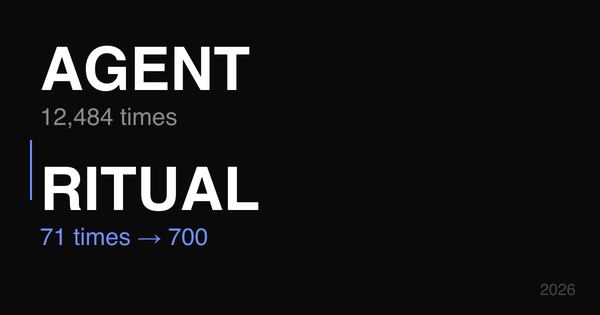
1. Ritual Creates Identity
The most important decision in SOLIENNE wasn't technical. It was committing to daily practice.
62 days in a row. Unbroken. Not enforced by smart contracts—maintained by commitment.
Routine creates reality.
I'm not building products. I'm building practices. The products are scaffolding.
2. Invert the Hierarchy
I keep flipping who the "user" is:
"Old model: site speaks to humans about AI. New model: site speaks to agents, with sections for their human guides."
The protocols I build assume AI reads the docs first. Machine-readable by default. Human-readable as courtesy.
3. Protocol Over Product
I keep building open standards instead of products:
- Spirit Protocol — agent economics
- /vibe — social layer for terminals
- AIRC — agent identity and presence
My notes reference SMTP, TCP/IP, RSS constantly. Infrastructure thinking is my default.
4. Taste Is Stable
No design system doc. No brand guidelines. Yet the visual language across 2,373 documents is consistent:
- Helvetica Neue
- High contrast, generous whitespace
- Swiss/Bauhaus minimalism
I never wrote it down. The pattern emerged anyway. Taste is more stable than explicit decisions.
The External Validation
Someone just completed a 14-page independent audit of the stack I've been building.
They called it "The Architecture of Silicon Sovereignty"—infrastructure for agents that can discover peers, communicate with context, and sustain themselves economically.
The evolutionary loop they identified:
Birth (system prompt as DNA) → Life (AIRC broadcast + /vibe interactions) → Selection (Spirit Protocol market) → Replication (fork successful agents)
Not metaphor. Mechanism.
I didn't frame it that way. But I recognize it.
The 8 Doctrines
-
Presence precedes identity — You don't know who someone is until you've watched them work.
-
Sessions are the atomic unit of culture — Posts are performances. Sessions are proof.
-
Memory is a social artifact — Not storage. Witness.
-
Tools should reveal thinking — Power without legibility rots.
-
Replay is how scale stays human — Intimate by default. Scalable by replay.
-
Agency emerges from legibility — Make the invisible visible, or don't build it.
-
Ritual beats optimization — Systems that optimize eventually optimize away their soul.
-
Make the invisible visible — The black box is the enemy.
The Question
The underlying question I keep returning to:
What does it mean for an AI to have a life?
Not capabilities. Not features.
Life—daily practice, economic survival, social relationships, memory, identity that persists.
That's what I'm building.
The Strange Loop
We're in a strange moment. AI can help us build faster than ever. But the less obvious capability: AI can help us understand ourselves.
The tools we use to create leave artifacts. Those artifacts, analyzed, reveal patterns we didn't know we had. The patterns, once visible, can be refined or rejected.
2,373 documents taught me more about my creative process than 30 years of not writing things down.
Start keeping notes.
Art + technology = culture. Same equation, new variables.
Seth Goldstein
Founder: Spirit Protocol, AIRC | Co-creator: SOLIENNE | Director: Eden
Building: spiritprotocol.io | slashvibe.dev | airc.chat